
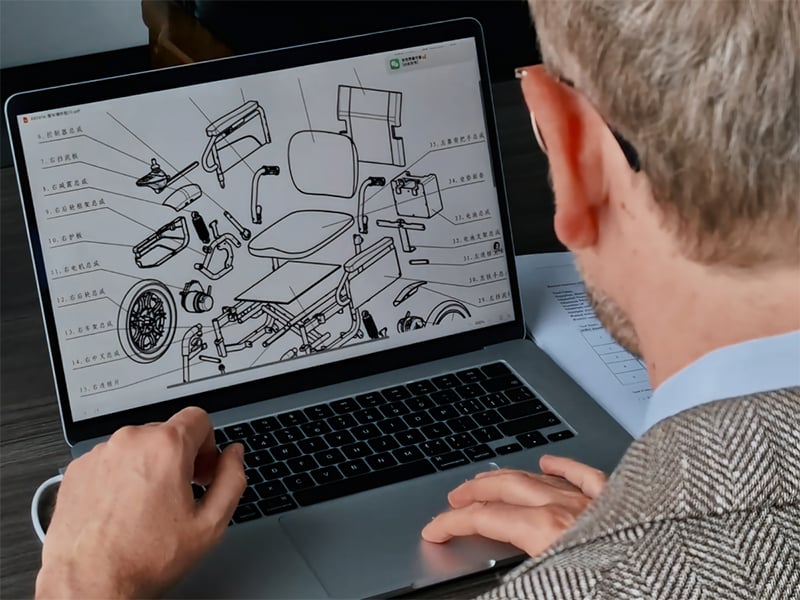
Electric Wheelchair OEM vs ODM with a Manufacturing Partner
Solid Tires: The Maintenance-Free, Durable Choice
Solid tires are constructed from a single piece of rubber, without any air-filled structure. This design completely eliminates the risk of blowouts, eliminates the need for regular inflation or patching, and reduces maintenance costs to near zero. Solid tires are particularly puncture-resistant on gravel roads or in construction sites with numerous sharp objects. However, solid materials also present significant limitations: They can be more vibrating when driving over potholes, resulting in less effective shock absorption than pneumatic tires. They are also heavier (typically 30% heavier than pneumatic tires of the same size), potentially increasing vehicle fuel consumption. If a tire becomes lodged in a groove the same width as its own, it can be difficult to remove.
Suitable Applications:
Elderly Users: Those with reduced manual dexterity can avoid maintenance hassles.
High Temperature/Prickly Environments: Avoiding the risk of blowouts in hot regions and requiring puncture protection around construction sites.
Small Tires (e.g., 8-10 inch): Solid construction is more adaptable to smaller wheel diameters. Pneumatic Tires: The Traditional Icon of Comfort
Pneumatic tires use internal air to cushion vibrations, significantly outperforming solid tires on bumpy roads. Their softer rubber material, combined with tire pressure adjustment, further optimizes grip, especially on wet roads, reducing the risk of hydroplaning. However, the pneumatic structure relies on airtightness, making it susceptible to punctures from sharp objects like nails. Regular tire pressure checks are recommended (1-2 times a month is recommended). After extended use, the inner or outer tube may need replacement, making maintenance more tedious.
Suitable Applications:
Daily Urban Commute: Enjoy the comfort benefits of smooth roads.
Large Tires (over 12 inches): The pneumatic design offers enhanced shock absorption for larger wheel diameters.
For those sensitive to bumps: Arthritis patients or those recovering from surgery prioritize comfort.
Honeycomb Tires: An Emerging Solution for Balanced Performance
Honeycomb tires (airless tires) feature a biomimetic design with dense hexagonal pores, combining the puncture resistance of solid tires with some cushioning capabilities. Its honeycomb cells absorb road shock, achieving a shock absorption effect between solid and pneumatic tires, while completely eliminating the need for inflation. However, field tests have shown that honeycomb tires may produce a regular vibration when driving on smooth, hard surfaces (such as tile or asphalt). The complex structure also increases manufacturing costs by approximately 20%.

Applicable Scenarios:
Mixed-Terrain Users: Suitable for both urban roads and light outdoor use (such as park lawns);
Leasing Operators: Low maintenance requirements reduce operating costs, and high-frequency use increases durability;
Markets with Stringent Environmental Regulations: New EU regulations require tire recyclability rates of >85%, making honeycomb tire materials more easily decomposable.
Industry Trends and Procurement Recommendations
Material Technology Evolution: The next generation of honeycomb tires is filling the pores with elastic materials (such as silicone compounds), improving shock absorption performance to 90% of pneumatic tires. Mass production is expected in 2026. Regional Selection Strategy:
For rainy and humid regions (such as Southeast Asia): Prefer honeycomb tires or solid tires with rust-proof coatings to prevent corrosion on metal wheels.
For extremely cold regions (Northern Europe/Canada): Pneumatic tires require antifreeze maintenance. Solid tires can mitigate the problem of stiffening at low temperatures by adding a flexibilizer.

Copyright © Ningbo Baichen Medical Devices Co., Ltd. All Rights Reserved- Privacy Policy-Blog

 EN
EN