
Electric Wheelchair OEM vs ODM with a Manufacturing Partner
In Japan—the nation with the most advanced aging population in the world—electric wheelchairs and mobility scooters have long ceased to be mere "medical devices"; instead, they have become integral mobility tools woven into the very capillaries of daily urban life. Baichen’s global market research team recently conducted a specialized study on age-friendly mobility aids in Japan, revealing a product design philosophy that differs significantly from those in Western markets. Three key principles—Narrow, Lightweight, and Precise—dominate the design direction. These insights drawn from our neighboring country have provided Baichen with a fresh perspective for the iterative development of our own product lines.
I. Narrow: Adapting to the "Minimum Clearance" of Japanese Homes and Public Facilities
The doorways in typical Japanese homes generally measure between 70 and 75 centimeters in width (adhering to the traditional "shakuroku" standard); in rental properties and senior living apartments, these widths can be even narrower, dropping to as little as 65 centimeters. In contrast, standard wheelchairs in Western markets typically measure 65 to 68 centimeters in width; once armrests are added, the actual clearance required for passage often exceeds 70 centimeters, making indoor maneuverability within Japanese spaces extremely difficult.
Consequently, the Japanese market imposes rigorous requirements regarding the maximum width of electric wheelchairs. Mainstream models are designed with an overall vehicle width kept strictly between 58 and 62 centimeters. Furthermore, armrests are designed to either flip upward or retract inward, thereby reducing the lateral footprint by an additional 10 to 15 centimeters. Moreover, public infrastructure in Japan—including subway turnstiles, convenience store entrances, and public restroom stalls—is designed around a 60-centimeter clearance baseline; wheelchairs must be capable of passing "straight in and straight out" without the need for sideways maneuvering or reversing.
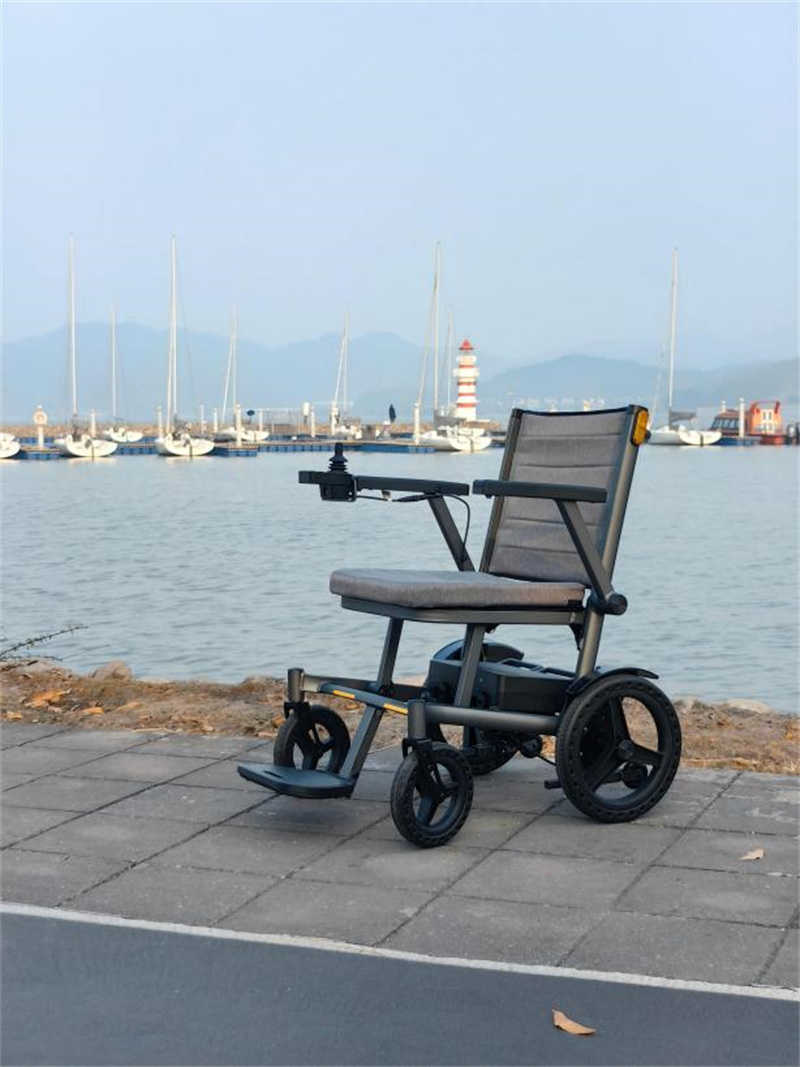
Drawing upon these Japanese standards, the Baichen design team has developed a new aluminum alloy wheelchair model—set for release in 2025—featuring a reduced frame width of just 59 centimeters. This model incorporates a one-touch quick-release armrest system, allowing users to completely detach the armrests in under three seconds and navigate through passages as narrow as 55 centimeters. During pilot sales at our Japanese dealerships, user feedback indicated a 70% improvement in the ability to successfully navigate through tight spaces.
II. Lightweight: Meeting the Real-World Need for "Single-Handed Portability" for Female and Elderly Caregivers
In Japanese households, the primary caregivers assisting wheelchair users are frequently spouses over the age of 65 or middle-aged to elderly women—individuals who typically possess limited physical strength. Consequently, the Japanese market is extremely sensitive to the "stowage weight" of electric wheelchairs—demanding not only that the entire vehicle be lightweight, but also that the weight of each individual component, once disassembled, remain within a range that a woman can comfortably lift with a single hand (typically ≤ 8 kg).
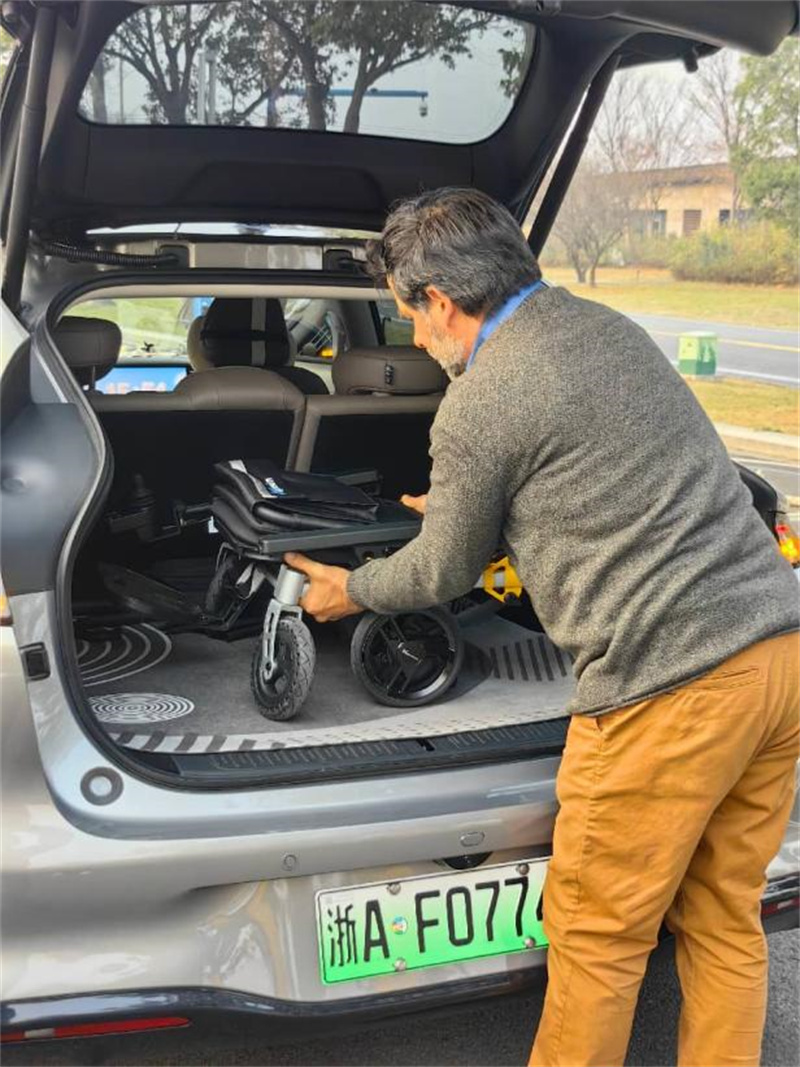
Mainstream Japanese brands commonly adopt a "separate frame, battery, and seat" design: the main frame weighs 12–14 kg, the battery module 2–3 kg, and the seat cushion 1–2 kg. Users can transport the unit in three separate lifts, allowing for easy stowage in the trunk of a *Kei* car (light automobile) or within a home's entryway storage cabinet.
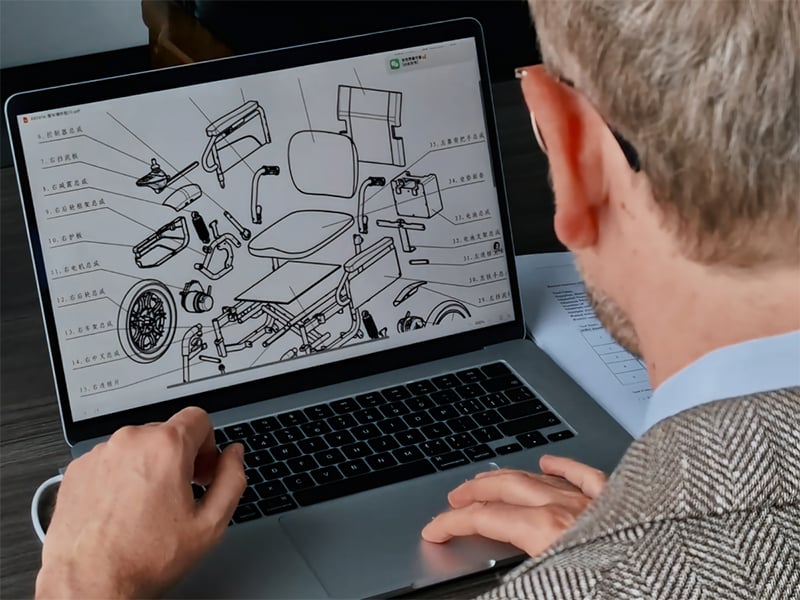
Drawing inspiration from this concept, Baichen has developed a "three-part modular" structure based on its existing carbon fiber folding series. In this design, the seat cushion, battery pack, and main frame feature independent quick-release mechanisms; the heaviest component—the main frame—weighs a mere 12.5 kg. Enhanced by standard-issue portable trolley wheels, the unit can be effortlessly wheeled across level ground much like a suitcase, thereby eliminating the need to bend down and lift the device manually. This design has already been filed for utility model patents in both China and Japan.
III. Precision: Operational Finesse for Seamless Subway and Bus Transitions
Japan's public transportation system is exceptionally wheelchair-friendly, yet it simultaneously imposes extremely rigorous demands regarding wheelchair maneuverability and precision. For instance:
Platform Gaps: On certain older railway lines, a lateral gap of 3–5 cm exists between the train and the platform; this requires the wheelchair's front wheels to align and engage with the gap's angle with pinpoint accuracy to prevent them from becoming wedged or stuck.
Access Ramps: The access ramps at bus entrances typically measure only 50–60 cm in width; consequently, the wheelchair must proceed in a perfectly straight line, maintaining precise lateral control with a deviation margin of no more than 2 cm.
Elevator Buttons: In Japan, public elevator buttons are typically installed at a height of 90–100 cm above the floor and are often arranged in close proximity to one another; this necessitates that the user manipulate the joystick to execute micro-adjustments with millimeter-level precision.
To address these specific scenarios, high-end electric wheelchairs in Japan are commonly equipped with a "Turtle Mode" (capping the maximum speed at 2 km/h) and a non-linear joystick response curve (where a slight nudge of the joystick generates only 5% of the maximum power output). Through an OTA update, the Baichen technical team has rolled out "Japan-Customized Firmware" for the S-Series wheelchairs exported to Japan. This update introduces a new "Train Boarding Mode," which reduces joystick sensitivity by 60% while shortening the electronic brake delay to just 0.1 seconds, enabling users to navigate platform gaps and narrow ramps with confidence.
IV. User-Centric Details: From "Quick-Flip Footrests" to "Nighttime Reflective Strips"
What often resonates most in Japanese elderly-friendly design is not the technical specifications, but rather the small, thoughtful details:
Quick-Flip Footrests: Users can flip the footrests upward using only their toes—eliminating the need to bend down when boarding or alighting.
Nighttime Reflective Strips: Japanese law mandates that wheelchairs operating at night must be equipped with reflective materials on their sides and rear; furthermore, these materials must be yellow or orange in color.
Baichen’s custom-edition wheelchairs for the Japanese market now feature these details as standard across the entire product line. Specifically, the "Quick-Flip Footrest" mechanism utilizes a spring-assisted design, requiring users to apply a force of just 1 kilogram to flip the rests—thereby significantly reducing strain on the lower back.
Baichen’s Initiative: Using Japan as a Benchmark to Enrich Global Design
Due to its extreme environmental constraints and the exacting demands of its users, the Japanese market serves as a "touchstone" for testing the human-centric design of electric wheelchairs. Baichen has spent years closely monitoring usage logs from 50 Japanese households. By 2026, Baichen plans to gradually introduce three proven technologies—the narrow-body frame, the split-frame transport structure, and the "Turtle Speed Mode"—into its product lines for the European and Southeast Asian markets.
We believe that truly excellent assistive devices for the elderly should be capable of effortlessly passing through every narrow doorway, smoothly ascending every step, and quietly accompanying every journey. Baichen will continue to refine its products with a global perspective, ensuring that wheelchairs bearing the label "Intelligently Made in China" embody the ultimate in human-centric warmth.
If you are interested in Baichen’s customized products, we invite you to visit the official Baichen website.
Ensuring peace of mind with every takeoff is Baichen's unwavering promise to its users.
Baichen is dedicated to leveraging innovative technology and user-centric design to provide global users with safer, more convenient, and intelligent mobility solutions. For more product information and mobility guides, please visit the official Baichen website.
Ningbo Baichen medical Devices Co.,LTD.,
+86-18058580651
Baichenmedical.com/baichenmobility.com

Copyright © Ningbo Baichen Medical Devices Co., Ltd. All Rights Reserved- Privacy Policy-Blog

 EN
EN