
 EN
EN

Understanding the FDA 510(k) Requirement for Wheelchairs
For any B2B importer looking to enter the North American market, the term "FDA cleared" is not just a marketing badge; it is a legal prerequisite. Under the United States Food and Drug Administration (FDA) regulations, most power wheelchairs are classified as Class II Medical Devices. This classification means they carry a moderate risk to the user and must undergo a Premarket Notification process, commonly known as the 510(k).
The 510(k) process is designed to demonstrate that the device to be marketed is at least as safe and effective — that is, substantially equivalent — to a legally marketed device (the "predicate device") that is not subject to Premarket Approval (PMA). For Baichen Medical, securing our 510(k) clearances was a multi-year investment involving rigorous testing at our 20,000㎡ Jinhua Yongkang factory, established in 1998.
Without a valid 510(k) K-number, a power wheelchair cannot be legally cleared through US Customs, and distributors risk severe penalties, including product seizure. As a specialized manufacturer, Baichen provides the "K-number" as the ultimate insurance policy for our partners at Amazon US, Costco, and Pride Mobility.
Decoding Baichen’s K-Numbers: K232121 and K250475
When evaluating a supplier, checking their K-number in the FDA’s 510(k) Premarket Notification Database is the first step in due diligence. Baichen operates with two distinct primary clearances that cover our evolving product lines:
1. K232121: This is our foundational clearance for a wide range of power wheelchairs. It validates our core electronic systems, including our sine wave vector control technology and the structural integrity of our frames.
2. K250475: Our newest 2025 registration, covering advanced lightweight materials and new folding mechanisms found in models like the BC-EM808 (Guinness World Record for smallest fold) and our carbon fiber series (BC-EC8003).
Each K-number corresponds to a massive technical file. For instance, the BC-EA5516B (18.5kg aluminum model) is built under the quality controls specified in these filings. Having two distinct registrations is a rarity among Chinese factories; most smaller workshops piggyback on third-party licenses or have no registration at all, creating a massive legal risk for the importer.
The Concept of a "Predicate Device" in Wheelchair Registration
The heart of the 510(k) process is the identification of a Predicate Device. You cannot simply claim a wheelchair is safe; you must prove it is "substantially equivalent" to an existing product already on the US market.
When Baichen submitted for K232121, we had to compare our products to established predicates in terms of:
· Intended Use: Mobility for individuals limited to a seated position.
· Technical Characteristics: Battery type (Lithium-ion vs Lead-acid), motor wattage, and controller sensitivity.
· Safety Features: Electromagnetic Compatibility (EMC) and environmental resistance (IP6 waterproof rating).
By proving that our BC-EA9000-UP (capable of carrying 200kg) performs with the same safety profile as top-tier US brands like Drive or Pride, we earned the right to bear the FDA clearance mark. This benchmarking ensures that when a US dealer buys from us, they are getting "Tier 1" engineering at factory-direct pricing.
Step-by-Step FDA 510(k) Submission Format (21 CFR 890.3850)
The FDA regulates wheelchairs under 21 CFR 890.3850 (Powered wheelchair). To secure clearance, a manufacturer must compile a Traditional 510(k) submission, which typically includes 20 specific sections.
| Section | Content Requirement | Baichen's Compliance Standard |
| Indications for Use | Definition of the target patient population. | Meets US hospital and home-care standards. |
| Device Description | Schematics, BOM (Bill of Materials), and engineering specs. | Full transparency on our Jinhua factory output. |
| Substantial Equivalence | Side-by-side table against the predicate device. | Verified against US industry leaders. |
| Biocompatibility | Testing of materials touching the skin (cushions, armrests). | ISO 10993 compliant; skin-safe foams and fabrics. |
| Software Validation | Documentation of the controller's code logic and safety stops. | Sine wave vector control firmware verified. |
| Electrical Safety | Testing to IEC 60601-1 standards. | UL and TUV certified electrical systems. |
| Performance Testing | Bench testing (curb climbing, static stability, braking). | EN 12184 / RESNA standards met. |
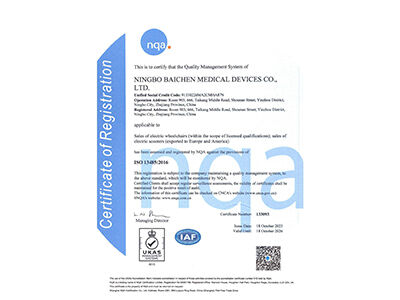
At Baichen, we don't just rely on our ISO 13485 quality system; we proactively perform "worst-case scenario" testing on every new model before it enters the FDA pipeline. This ensures a 100% success rate during the review.
Timeline of the FDA Review Cycle: The 90-Day Reality
One of the biggest misconceptions in B2B procurement is how long "getting FDA" takes. The FDA has a statutory goal to complete a 510(k) review in 90 days. However, this is rarely the "real" timeline.
· Days 1-15: Acceptance Review. The FDA checks if the file is complete (RTA - Refuse to Accept policy).
· Days 15-60: Substantive Interaction. The Lead Reviewer analyzes the data.
· Days 60-90: Additional Information (AI) Request. The "clock" often stops here. The FDA may ask for more testing data.
· Final Decision: Typically reached between 120 to 180 days total from submission.
For a distributor, this means you cannot "rush" a new model into the US market. This is why partnering with an established supplier like Baichen is vital. Because we already hold K232121 and K250475, we can often add new models via a "Note to File" or a "510(k) Modification" if the changes are within certain parameters, drastically reducing your time-to-market compared to starting a new registration from scratch.
Why ISO 13485 and CE MDR Complement the FDA Process
While the FDA 510(k) is the law of the land in the US, global B2B buyers should look for the "Triple Crown" of certification: FDA, ISO 13485, and CE MDR.
· ISO 13485: This is the quality management system specific to medical devices. While the FDA focuses on the product, ISO 13485 focuses on the factory. It ensures that the wheelchair we build today is identical in quality to the one we built six months ago.
· CE MDR 2017/745: For European distributors, the new Medical Device Regulation (MDR) is even stricter than the FDA in terms of clinical evaluation. Baichen’s compliance with MDR ensures that our products meet the highest safety standards in the world.
Our 20,000㎡ Jinhua Yongkang facility is audited annually to maintain these standards. When you see our BC-MS3331 3-wheel scooter in a US pharmacy or a European hospital, it is there because of this complex, multi-layered regulatory architecture.
Frequently Asked Questions
Q1: Can I use Baichen’s 510(k) K232121 for my own private label brand?
Yes. Through a "Letter of Authorization" (LOA), we can link your private label brand to our existing 510(k) registration. This allows you to market the product under your own name while relying on our established regulatory clearance.
Q2: Is the FDA 510(k) the same as FDA Registration?
No. Many factories say they are "FDA Registered," which just means they paid a fee to be on a list. "FDA Cleared" (510k) means the FDA has actually reviewed the product's safety data and issued a K-number. Always ask for the K-number.
Q3: Does the 510(k) cover the battery safety?
The 510(k) file includes the battery specifications, but for shipping, you also need UN38.3 and MSDS reports. Baichen provides a complete compliance package including FDA, UL (for electronics), and IATA-compliant battery documentation.
Q4: Do manual wheelchairs require a 510(k)?
Most standard manual wheelchairs are Class I and are "510(k) Exempt," but they still require FDA Establishment Registration and Device Listing. Power wheelchairs are Class II and almost always require the full 510(k).
Q5: How can I verify if K232121 is real?
You can visit the FDA 510(k) Database and type "K232121" or "Ningbo Baichen" into the search field. Transparency is the hallmark of a professional B2B supplier.
Conclusion & Next Step
The FDA 510(k) process is the ultimate filter that separates professional medical manufacturers from hobbyist assemblers. By holding dual clearances under K232121 and K250475, Baichen Medical offers a "plug-and-play" solution for North American distributors. Whether you are sourcing the ultralight BC-EC8003 carbon fiber wheelchair or the heavy-duty BC-EA9000-UP, you can rest assured that the regulatory heavy lifting is already done.
Ready to expand your mobility catalog with a compliant, high-margin partner? Contact our US Compliance Team for a copy of our 510(k) Summary and ISO 13485 certificates.
Table of Contents
- Understanding the FDA 510(k) Requirement for Wheelchairs
- Decoding Baichen’s K-Numbers: K232121 and K250475
- The Concept of a "Predicate Device" in Wheelchair Registration
- Step-by-Step FDA 510(k) Submission Format (21 CFR 890.3850)
- Timeline of the FDA Review Cycle: The 90-Day Reality
- Why ISO 13485 and CE MDR Complement the FDA Process
- Frequently Asked Questions
- Conclusion & Next Step