
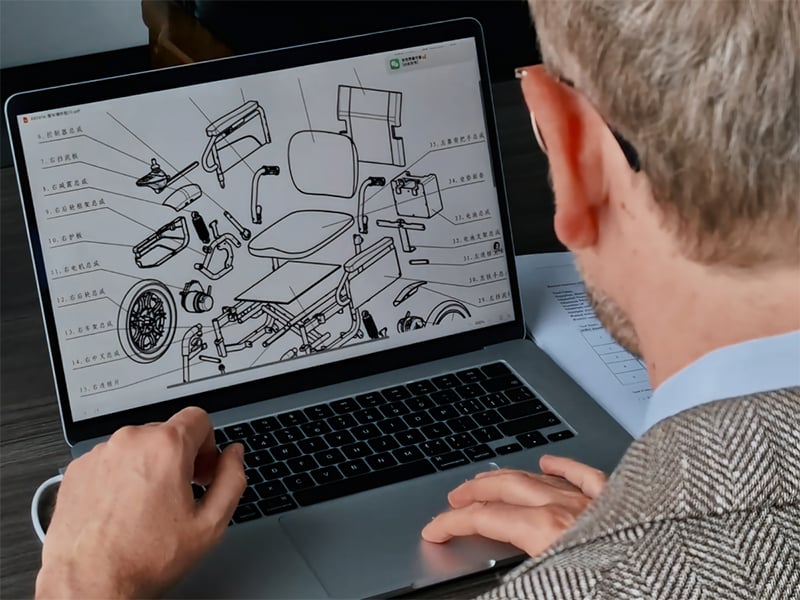
Electric Wheelchair OEM vs ODM with a Manufacturing Partner
Magnesium alloy wheelchairs are currently transitioning from emerging technology to large-scale application. Their unique material properties offer significant advantages, but they also face some cost and process challenges. The following is a comprehensive analysis:
Core Advantages of Magnesium Alloy Wheelchairs
The core competitiveness of magnesium alloy wheelchairs is primarily reflected in the following aspects:
Extreme Lightweight: This is the most significant advantage of magnesium alloy. Its density is approximately two-thirds that of aluminum alloy and one-quarter that of steel.
Strength and Durability: Due to its high specific strength (strength-to-density ratio), the frame maintains structural strength and stability while reducing weight, making it less prone to deformation.
Shock Absorption: Magnesium alloy has a high damping capacity, effectively absorbing and dissipating vibrations during driving, making it particularly suitable for use on bumpy roads and enhancing ride comfort.
Electromagnetic Shielding: Magnesium alloy effectively shields electromagnetic interference.
Heat Dissipation and Processability: Magnesium alloy exhibits excellent heat dissipation performance.

Production Process and Major Challenges
The production and promotion of magnesium alloy wheelchairs primarily face the following challenges:
Profile Processing Difficulty: Magnesium alloy profiles are prone to bending and deformation during the extrusion and straightening processes. Due to its poor plasticity at room temperature, defects such as wrinkling, distortion, and inconsistent springback are prone to occur when molding complex shapes (such as thin-walled and multi-ribbed structures). These process challenges result in low yields and increased production costs.
Relatively high costs: Raw material prices, complex processing techniques, and high scrap rates all contribute to the higher manufacturing costs of magnesium alloy wheelchairs compared to those made of traditional materials.
High production costs and the need for continuous improvement in processing technology are currently the main factors hindering their widespread adoption. However, with continued technological advancements, the maturing of the industry chain, and the growing market demand for lightweight products, the cost of magnesium alloy wheelchairs is expected to gradually decrease, further expanding their application.
Ningbo Baichen medical Devices Co.,LTD.,
+86-18058580651
Baichenmedical.com

Copyright © Ningbo Baichen Medical Devices Co., Ltd. All Rights Reserved- Privacy Policy-Blog

 EN
EN